


The Pause That Shows You Things

Updated: Jul 9
This piece is the third part of the Making Life Workable series —
a lived exploration of what happens when something doesn’t feel quite right anymore,
while everyday life continues around it.
Each part looks at a different moment in that experience —
not to tell you what to do, but to help you notice what might already be there.
You don't need to read this series in order. Just start wherever something feels familiar.
If you're new to this series, you're welcome to continue reading here. If you'd prefer to begin at the start, Part 1 is here.
Part 3 - What you begin to notice when life slows down.
Sometimes, things slow down —
whether you meant them to or not.
And once the pace changes,
you start noticing what it was taking
to keep everything going.
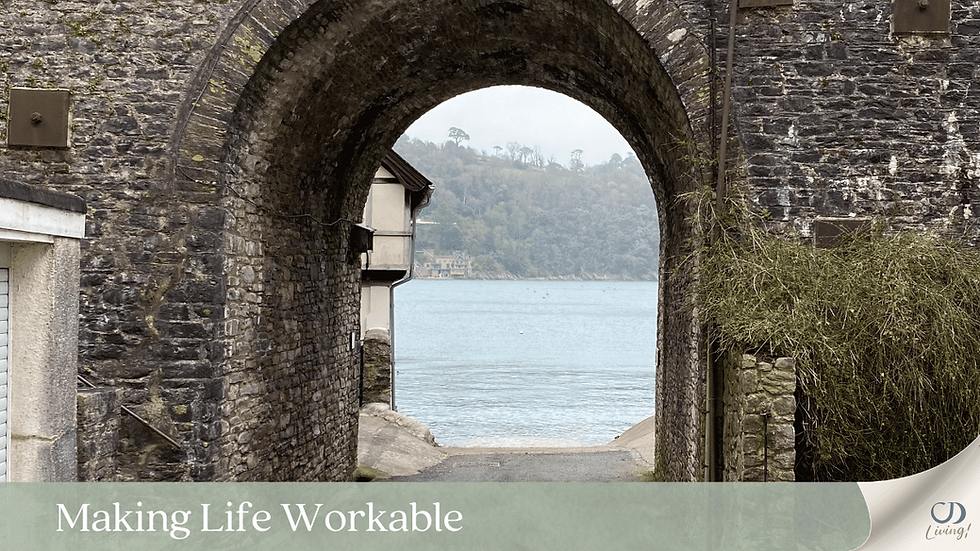
There are times when things slow or shift — sometimes by choice.
And sometimes because life interrupts the way things were moving.
Not always because you chose it.
Not always because you were ready.
But because something changed.
Sometimes the thing that changes is simply that you can’t keep doing things the way you were doing them anymore.
Sometimes that shows up in the body.
Sometimes it shows up in circumstances.
Sometimes it’s both at once.
You try to keep going, but your body won’t cooperate.
You’re exhausted in a way sleep doesn’t fix.
Your head feels foggy.
Your patience thins.
Things feel harder than they should.
You may still be managing most things —
but it takes far more effort than it used to.
And eventually, you’re not choosing to step back.
Things slow down or change
because your body, your life, or something in you
is no longer able to keep up in the same way.
Sometimes it looks like a move.
A break in routine.
A change in where or how you’re living.
Or life not unfolding the way you expected.
Sometimes it’s quieter than that.
Just a moment where you realise how much effort it’s been taking
to keep everything going —
and you don’t want to keep doing things that way anymore.
Sometimes other people can see the change. Sometimes it barely looks like anything from the outside.
But from the inside, it can change what you can’t unsee.
And once you’ve seen it,
it can feel harder to keep doing things in the same way.
Because when things slow down or change — even slightly —
you start to notice what was being held together by effort.
What you were tolerating.
What you were pushing past.
What you were smoothing over just to keep things running.
And what’s strange is this:
A lot of people only realise how tired they are once things slow down. Not because the tiredness is new — but because it was being outrun.
When things slow down, you can’t distract yourself in the same way.
You start noticing things.
That you don’t bounce back from normal days the way you used to.
That you’ve been living at a level of pressure that started to feel normal.
That quiet feels unfamiliar.
That you don’t actually know what you need —
because you’ve been focused on everyone else’s needs
and what needs to be done.
Sometimes that brings relief.
Sometimes it brings restlessness.
Sometimes it brings guilt or blame.
Sometimes it brings that quiet feeling
that you should be handling things better.
And this is often where people try to “fix” it.
Not because something is wrong —
but because not knowing feels uncomfortable when you’ve kept things going for so long.
When things have been moving at that pace for a long time,
slowing down can feel like losing your footing.
Especially when everything around you is still moving.
Plans still happen.
Messages still come in.
There are still things that need doing.
And whether anyone is asking it of you or not,
there can still be that pull
to keep doing what you’ve always done.
Doing anything other than that can feel like stepping out of your role.
And without that role,
things can feel a bit exposed.
And when that happens, pressure often shows up.
The urge to decide.
To explain.
To make things look settled again.
Because when things look settled, everyone else feels more comfortable.
This kind of time is often misunderstood.
It can look like stopping.
Like drifting.
Like not knowing what you’re doing.
You might tell yourself:
I should be doing more with this time.
I should have figured this out by now.
Shouldn’t I feel better than this?
Other people seem unbothered — so why aren't I?
Even when it feels messy, this time can still show you something.
It shows you what’s underneath the pace. What helps. What doesn’t.
Not what sounds like it should help —
but what actually makes the day feel more manageable.
What starts showing up again the moment you try to go
“back to normal.”
What eases when you stop pushing so hard.
It’s easy here to start replaying everything.
To look for what went wrong.
To try and make the discomfort disappear.
But often the more useful question is simpler:
What is this showing me?
And usually, what it shows isn’t dramatic.
It’s small, everyday things.
You might notice:
You need more quiet than you thought.
More space between plans.
More time to recover after being around people.
A slower start to the day.
Less rushing in the evening.
Not because you’re incapable.
Because you’re human.
This time can also show you what “fine” has really meant.
Sometimes “fine” meant keeping things going.
Sometimes it meant pushing past things that weren’t really working.
When the pace drops,
it becomes harder to ignore
how much effort it took
to keep everything looking ok.
And that matters.
Because making life workable isn’t always about big decisions.
Sometimes it starts with something simpler: Noticing what actually helps — and letting that matter.
Even if nothing changes yet.
Once you’ve seen what’s been happening underneath,
it can become harder to keep doing things in the same way.
Even if nothing has fully changed yet.
Part 4: 🔗 When What You Were Doing Stops Working
This sits within Emotional Wellbeing — where emotions are treated as information, not something to fix.
Emotions don’t need solving. They need space to move.

Whatever brought you here today, I hope you leave with something that helps life make a little more sense, or perhaps opens the door to something you hadn't noticed before.
🧭 Where To Go Next
🔗 Browse by Experience — explore what feels most familiar.
🔗 A Note From Jen — reflections that put words to experiences many people struggle to explain.
🔗 Begin Here — understand this approach and where to begin.
🔗 Find What Fits — explore resources, support and practical next steps.
✉️ Get updates by email — receive new reflections and resources as they're shared.


Comments